Monday, October 8, 2012

17th Light Dragoons


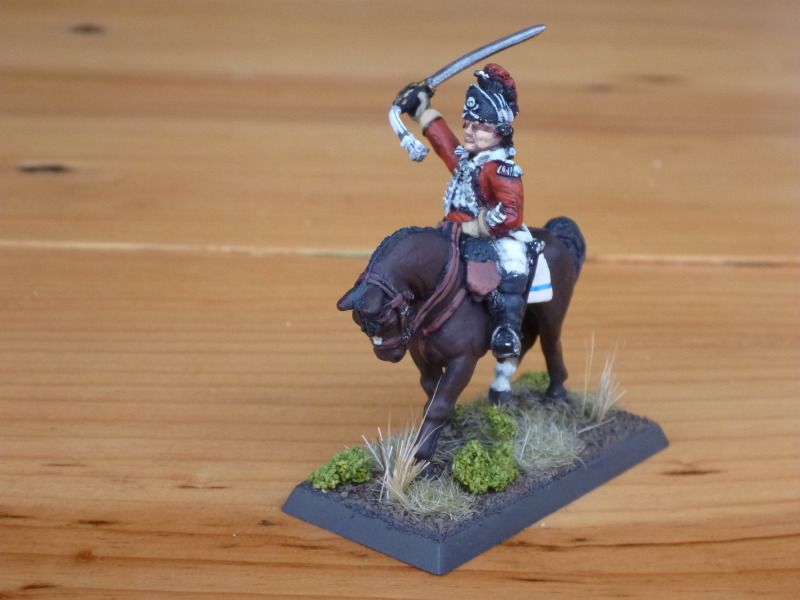
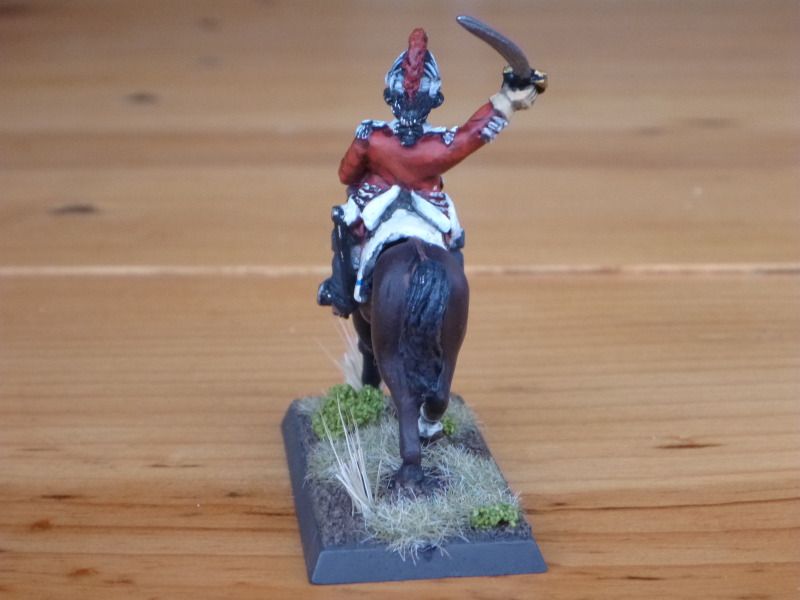
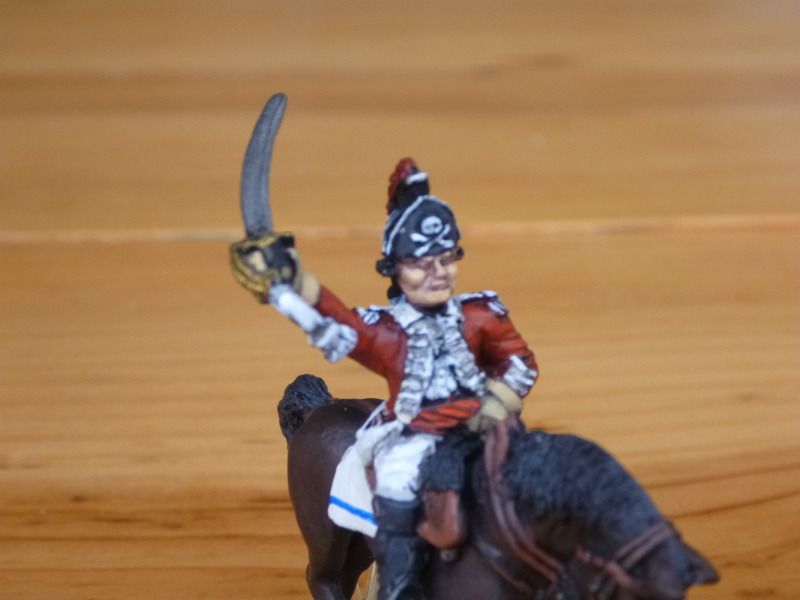
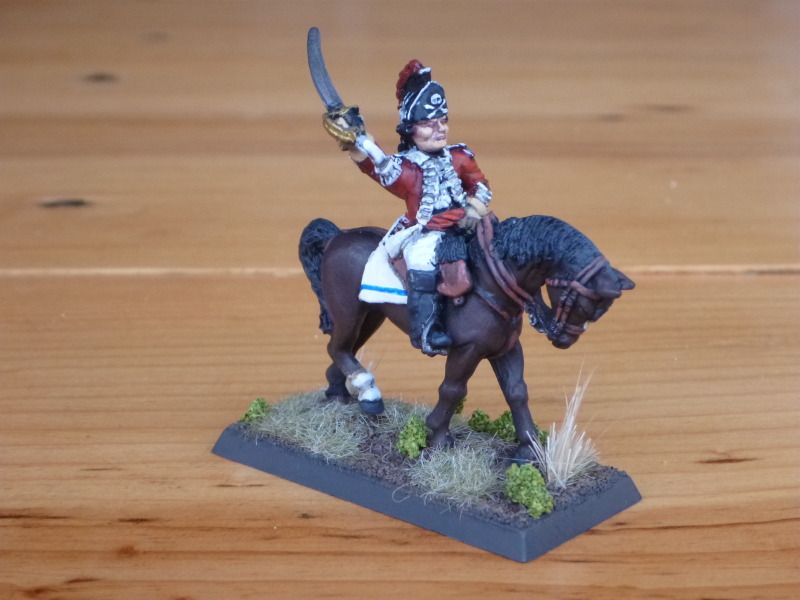
Providing cavalry support to my AWI Crown Forces, I am working on a squadron of His Majesty's 17th Light Dragoons. As I have probably stated before, I really enjoy painting horses. I treat them as a second character, and enjoy adding the small details like socks and blazes to give each horse its own unique personality.


As is turning out to be somewhat common, many of the historical depicitions of these particular uniforms disagree with each other on the details, What I have gathered for certain are that they wore red coats with white facings, with white lace, and a red-crested helmet. I have seen several variations on the small clothes, between what looks like wool, linen, and leather. I chose 


As to basing, I used my paint journal to match the soil color to my previous colonial miniatures. The foliage and flock present was chosen to give the appearance of crossing an open field, so the terrain is mostly grassy, with a few small shrubs, and tufts of higher grass, made the same way as my African grassland bases, but shorter. As in the case of the FoW German bases, these are largely influenced by my grandparents' farm's pasture.


Wednesday, October 3, 2012

Bretonnian Questing Knight

As another fun change-up, today I present a figure from Games Workshop's Warhammer Fantasy Battles range. I have been [very] slowly working on  Bretonnian force, which is based on Chivalric Knighthood and the Arthurian Legend. In my opinion, these are some of the best scuplted figures GW offers.


This particular knight is a Bretonnian Questing Knight. These knights have gone above and beyond normal chivalric vows, eschew their lances, and go on the noblest of quests in search of visions of the Holy Grail. They apparently aren't at all adept at traveling light. Our current nobleman rides into the field bedecked with a chest of drawers among his equipage.


This sudden resurgence of interest in fantasy knight figures is owed in no small part to Agincourt by Bernard Cornwell, and to A Song of Ice and Fire by George RR Martin. Between these two I have suddenly found the motivation to take the brush to some patiently waiting archers and knights. 

Knights are a fun challenge for the miniature painter. Done properly to the standards of history, legend, and fantasy literature, they should each wear their own unique sigil, and wear the colors and devices of their houses. Doing large batches of knights at a time can be creatively exhausting as you scrape the far corners of imagination for any remaining kernels of ideas. I try to stick to strict heraldic colors, being red, yellow, blue, black, and white.


The sigil for this knight is a Fleur de Lis, reversed black on white or white to black. The devices are free-handed, though I did cheat and use a white paint pen for the white on black.  He is painted as a noble of Mousillon, a disgraced and somewhat suspect realm in Western Bretonnia. A fun detail on this particular figure is the chest of drawers and other baggage. I took the chance to create an illuminated manuscript on the open book, which is based , to the best of my painting abilities at this scale, on actual medieval and dark age illuminations such as the Book of Kells.


Though I wanted the figure to be predominantly black and white for the heraldry and barding, the overall effect was somewhat dull and muddled, so I added yellow as an accent to bring some interest and color to the composition. The stripes on the barding are actually taken from First World War German aircraft markings, but seem to hold the proper look here.


The basing has been influenced in no small way by Agincourt. In addition to normal base sand and flock, I have sculpted some hoof-prints in putty, so it could paint up as muddy ground. A drop of gloss varnish completes the look.


Hopefully my fantasy book series' will hold out long enough to do a few more knights and another group of longbowmen (did I mention the magic of painting with books on tape??!)

Tuesday, October 2, 2012

Paint Journal

One of the recurring themes for me lately has been the effect of an adult life on my hobbies. As I have mentioned before, it is more difficult to get games to happen...etc.

As the time between patining sessions stretches for weeks or months sometimes before you revisit any particular project, the limits of memory are tested as I stare at a blank model (or more often, base) and wonder how on earth I painted it last time. Trying to create continuity over an extended period of time, with life and career in between has become a real challenge. 

Reflecting back to a younger self being tutored by a more experienced painter, he had made a case for keeping a record of your paint schemes. Being young at the time, I tried it out, but lost interest, and eventually the journal, and figured I could remember what I painted on my models. As it turns out, it was of the best lessons he gave me.


The concept is simple, but the execution takes discipline. I have restarted my paint-journal, so that I can pick up on projects as I have the time and motivation, and make consistent and continuous units of miniatures. Since I tend to work in 2 or three color layers, I write down what each layer color is, from left to right, and paint a small swatch of the color, in case the manufacturer discontinues my shade, or changes its name.
As an example, here's my African explorer, now with a completed savannah base, painted to match the tribesman's. As I continue with my Africa series, I can always come back to the same basing system.


I am also thinking of making a library of color effects in this journal. Basically, this means that when i find a way of painting red that I really like:


I can be sure that I will be able to replicate it exactly later on. I think of this particlar method as having a lego drawer, where I can grab out parts that I know will work, instead of reinventing redcoat red every time I pick up a new set of British troops...


Saturday, September 29, 2012

...and now for something completely different

As a departure from my normal work, as well as a favor to my loving wife, Ive repainted a small garden gnome figure for our herb garden outside. Loni picked this guy up at the local grocery store as an unpainted white resin figurine.


He is picking up the slack for me, as I have clearly not been the best at watering my little herb garden. We didn't want to have a very loud, bright gnome as the center focal point of the garden, but rather would include him as a little secret to discover, hence the green and brown clothing. (On the left you can see his friend, the pet rock.)


I think he does a decent job of blending in, but without disappearing completely. When I am better about watering the basil, he has more foliage to wander though.


Here you can see the texture of his grey beard, and the gnome's striped brown trousers. The light colored spots on his tunic are deposits from watering. To acheive the basing look I used on this model, you will need a salad garden table, a bag of potting soil, basil and oregano seeds. After a few months of watering, I had the perfect herb-garden base for the miniature.

Wednesday, September 19, 2012

East African Tribesman

Thanks to a reenacting friend's donation, I have had the privilege of trying out the Perry Brothers' plastic Madhist Ansar set. I don't think I have ever seen so versatile a plastic set before. Though intended to portray the Madhist rebels of the Sudan war, with the multiple head and arm/weapon options, you can create a wide variety of peoples of North Eastern Africa. I will take advange of this versatility to create several smaller groups of figures, modifying some to Turkana


The first test figure is painted up a bit generically, with red cloth and a spear. I may add a plaid pattern to the clothing, since those are popular, and tend to end up in a lot of reference pictures. I do not, however, know at what point in history they became popular, but in my time in Kenya, I saw red plaid in wide use in rural areas, with several people groups. I did the skin using a modification from the Perry Brother's tutorial. 


The spear is painted very faintly silver, since many of the raw iron tips appear mostly black in person.


The basing is a refinement on my Gordon Highlander base, with a more subtle use of the bristle of the deep grass, so that it does not take over the figure. The hope is that en masse, the grass on the base will add up to a deep plain.

Friday, September 14, 2012

Gordon Highlanders in Africa


In a miniatures swap with a friend, I have ended up with a small supply of pith-helmeted highlander models., I at first thought it may have been either a Zulu or Sudan war figure, but on closer inspection is from Old Glory's Boer Wars range. After scrutinizing the figures and their equipment I decided to paint them up as Gordon Highlanders, with their own proprietary tartan. Hopefully it will be distinct enough at this scale, since it does bear some resemblance to the more common Black Watch plaid. The coat is khaki, since it has breast pockets, and I cannot find any illustrations showing red tunics with breast pockets. Khaki was also a decision based on the rifle he carries. At a distance it looks like a Martini Henry, but on closer inspection it has a box cartridge in front of the trigger and a bolt mechanism on the top, making it likely an early Lee-Enfield.


Pith helmet and belts done in white mostly for the sake of cool contrast on the miniature, though this may not be the most historic choice.


The base is intended to give an African feel, with red earth, and a mixture of greener low-growing turf and deep, straw colored savannah grass. The tufts of tall grass are bristles cut from a cheap paintbrush of the sort that shows up at every hardware store in America. I think I may have overdone the grass effect on this test model, and will likely tone it down a bit on the rest of his squad.

Thursday, September 13, 2012

Two if by Sea, or The Doctor is In


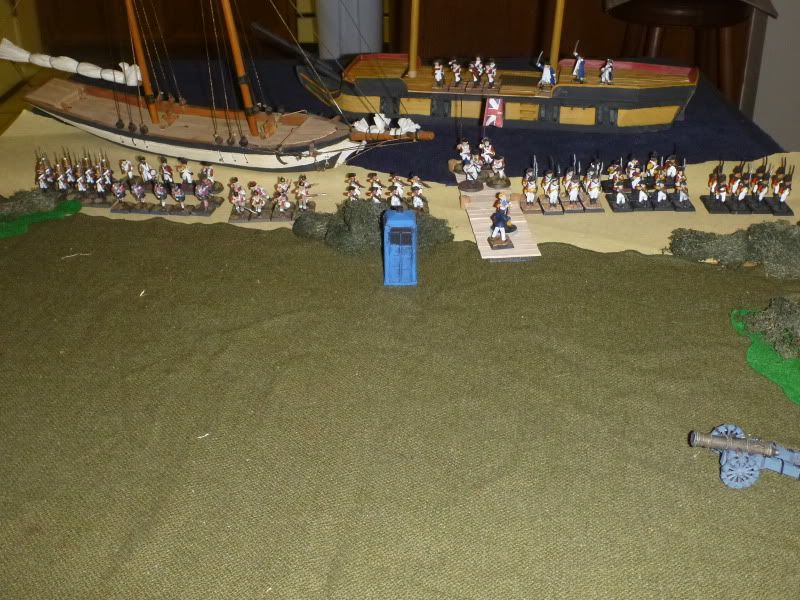
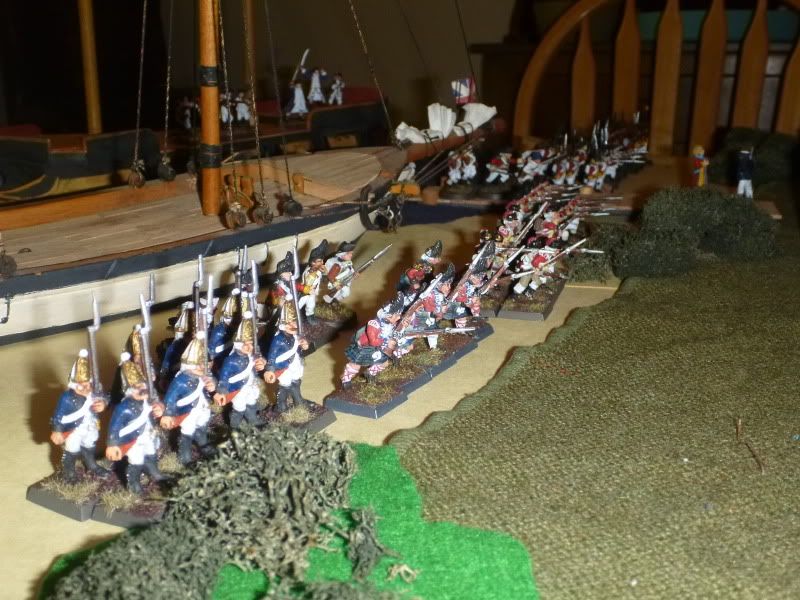
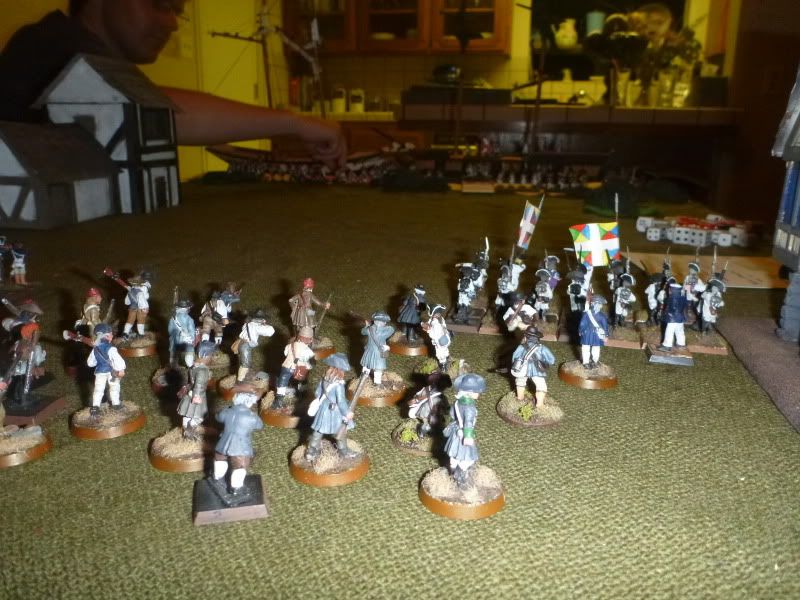
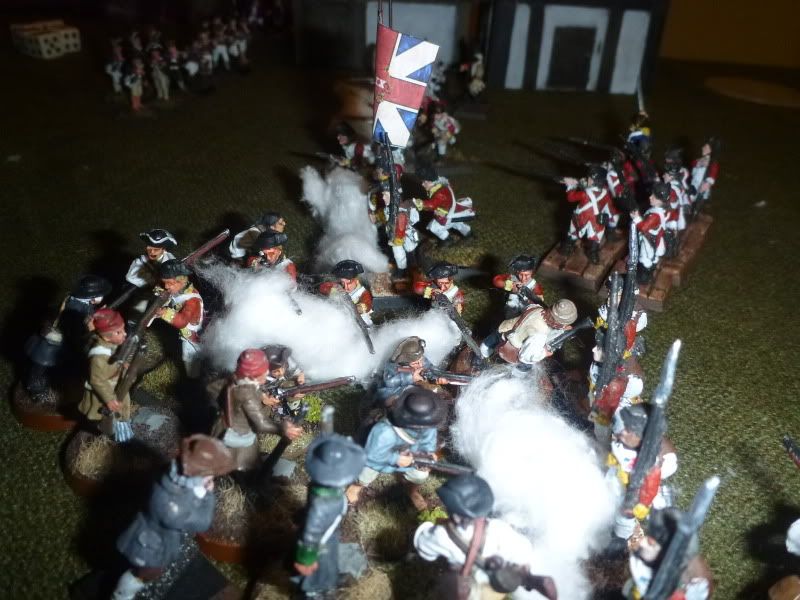
I recently had the pleasure of exercising my AWI figures in a game with Lord Z.E. Whitlow. We set up an amphibious landing scenario on my kitchen table. Not exactly a standard game table size, we had a playing field of about 3 x 7 feet, including about a foot and a half as water, featuring the HMS Sophie as transport, and a beached Dred Hawk


 We used a slight variation on the Alamo rules by Warhammer Historical, to account for the range difference between muskets and rifles.
For the scenario, the Crown Forces were to begin on their transport ships and/or beach, and attempt to sieze a munitions supply in a nearby coastal town.


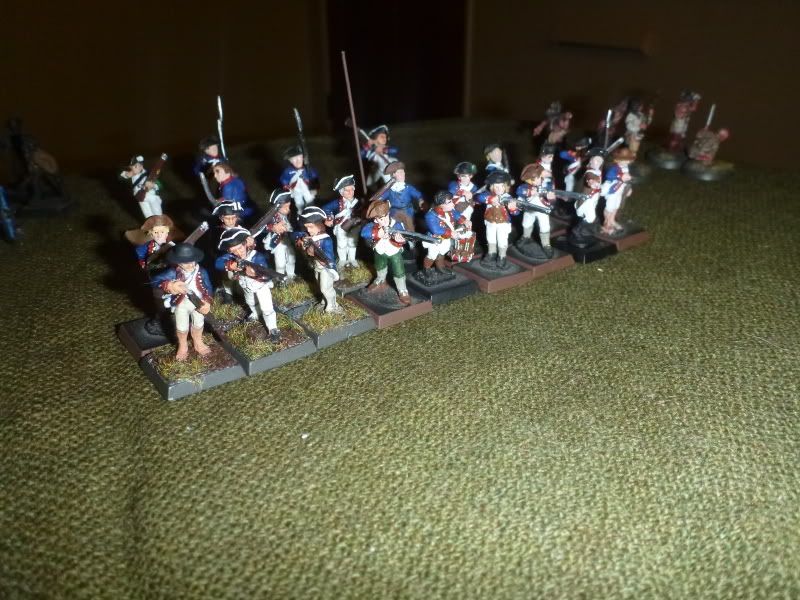
To oppose them, the local militia is called up, and aided with support from the Continental Army and French allied regulars. The British used the Texas Army list from Alamo, while the Continental force ran as a version of the Mexican army list, as it allowed for more of a militia presence.


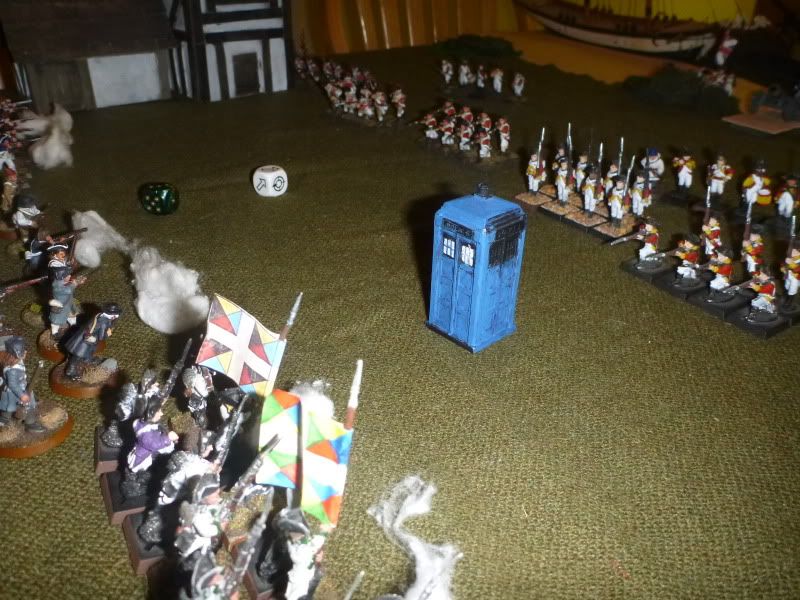
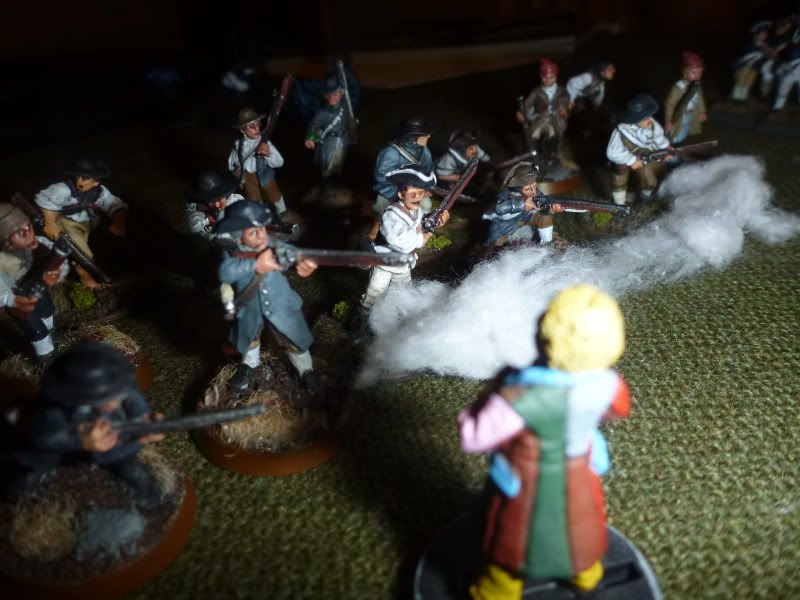
In addition to the battle, we also ran a game within a game, since Mr Whitlow has an impressive Dr Who miniature collection. The Doctor would randomly land within the game, and pursue a creature though the battlefield, attempting to bring it back to the TARDIS.


Abhorring violence, the Dr tries to convince the men he's landed in to stop killing each other.


...but to no avail.


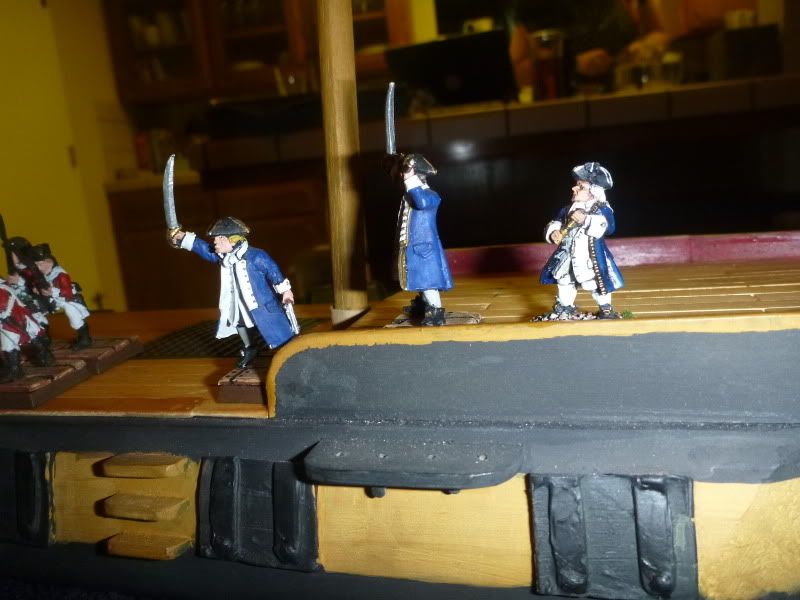
...while the Navy watched the battle, aloof on the harbor.


Related Posts Plugin for WordPress, Blogger...